DUPR
- 4.1
- Rating
- 100.00K
- Installs
- Free
- Price

 Analysis by App-foxy
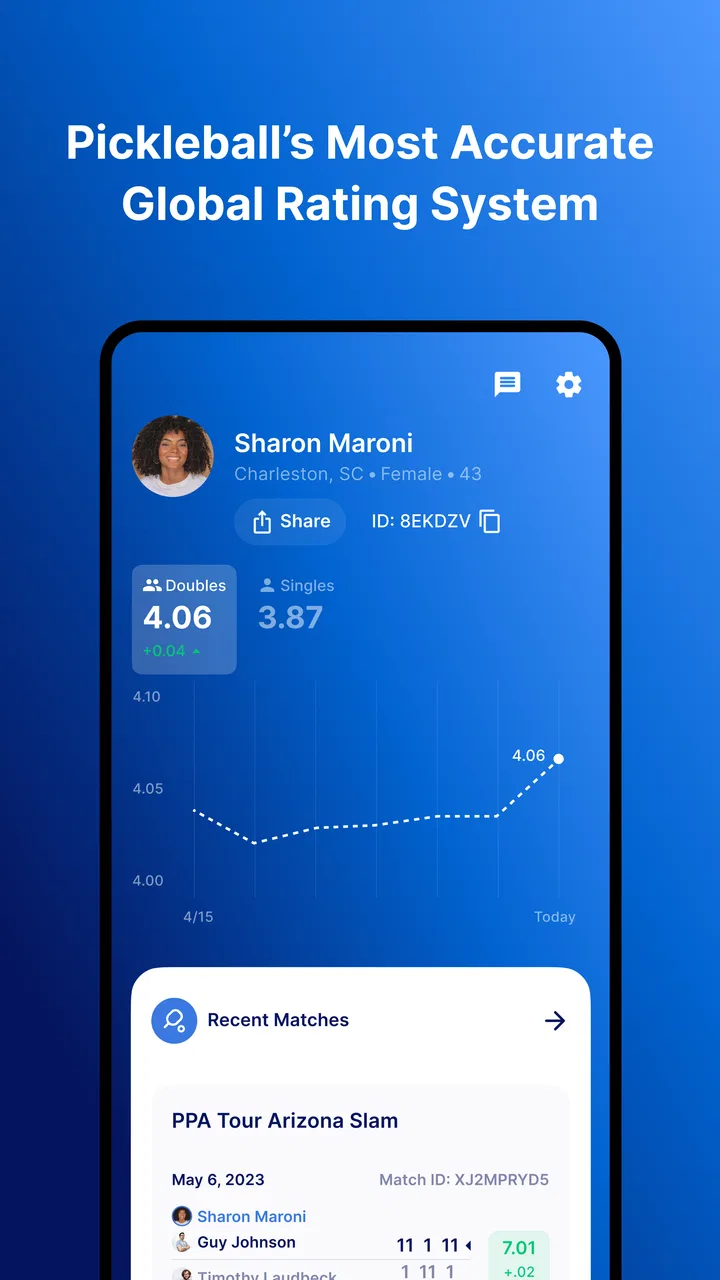
After a few pickleball matches, I often know who won but not whether the result says much about the players involved. A close win against strong opposition can mean more than an easy victory over beginners, and that is the gap DUPR is designed to address. This free sports app from DUPR turns recorded match results into a pickleball rating, giving regular players a more useful way to understand their level than wins and losses alone.
I found the idea most valuable when I stopped treating a rating as a badge and started using it as a conversation tool. It can help players find more balanced games, notice whether their level is changing, and make match history more meaningful. The app is not a replacement for good judgment at the court, though. Its usefulness depends heavily on accurate match recording, reliable opponents, and a willingness to let results build a picture over time.
From an unmeasured match to a useful pickleball rating
The starting condition is familiar: you play several games, remember the score for a while, and then struggle to compare one session with another. DUPR gives that routine a clearer destination. Instead of leaving a match as an isolated memory, you record it so the result can contribute to your player rating.
You May Also Like

 Blood Strike: 2.5 Anniversary
Blood Strike’s Loadouts Turn Every Drop Into a Tactical Gamble
A close look at Blood Strike’s custom loadouts: how fast access to signature weapons reshapes its battle royale rhythm, rewards preparation, and narrows the gap between fights.

 Pandora - Music & Podcasts
Pandora’s Music Is Easy to Start, but Harder to Recover
Pandora’s strength is its low-effort path from a seed to a station. Its weak spot is how much confidence it asks you to place in connection, setup, and quiet recovery.

 8 Ball Pool
 Is Built on Rivalries, Rematches, and Routine
A close look at the rivalries, rematches, shared routines, and unanswered safety questions that turn a quick pool match into a persistent mobile community.

 Samsung Music
’s Quiet Strength Is Playing What You Already Own
Its reach comes less from spectacle than from dependable access to a personal library. That simplicity is both the app’s strongest retention engine and its ceiling.

 AccuWeather: Weather Radar
AccuWeather Review: A Quick, Clear Forecast for Everyday Decisions
For everyday plans, the best forecast is the one you can understand quickly. AccuWeather makes rain timing, radar, and local conditions easy to act on, with a few trade-offs.

 Hill Climb Racing
Why Hill Climb Racing Still Turns Crashes Into One More Run
A tiny car, a bumpy hill and one more upgrade: Hill Climb Racing keeps resurfacing because its simple chaos makes every near-miss feel personal.
More From Our News Desk



That makes the app especially relevant for people who play with changing partners or opponents. A simple win-loss record does not explain the quality of the competition, the closeness of the game, or how your results fit together. A rating aims to provide more context, which is why this app feels different from a basic score tracker.
In my experience, the best way to approach DUPR is to begin with a practical question: what do I want the rating to help me do? If the answer is finding better-balanced games, checking progress, or giving other players a quick sense of my level, the workflow makes sense. If I only want a private record of scores, a notes app or a simple sports log may be quicker.
The app is listed in the Sports category and is available free of charge, with optional in-app purchases ranging from $1.99 to $34.99 per item. That combination makes it easy to try without committing money first, but I would still pay attention to any purchase screen before confirming anything. The core appeal is the rating workflow, not a large collection of unrelated extras.
What I would prepare before opening the app
The most important preparation is not technical. It is agreeing with the people you played against on the correct score and on whether the match should be recorded. If one person enters a different result, the rating process can become less useful. I recommend taking a quick note immediately after the game, especially during a busy club session when several matches blur together.
I would also avoid recording matches casually just to make the profile look active. A rating becomes more informative when the results represent real games played under normal conditions. That is one of the less obvious trade-offs: entering more matches is not automatically better if the entries are incomplete, mistaken, or disconnected from the level of competition you usually face.
The recording flow in everyday use
The basic workflow is straightforward in concept. After playing, I use the app to record the match rather than relying on memory. The outcome then becomes part of the information used to establish or update my pickleball rating. The store summary describes the app as a way to get an accurate rating by recording matches, and that focus is clear throughout the experience.
A realistic example would be a Saturday morning session with three different partners. I might win the first game comfortably, lose the second by a narrow margin, and split a close third match against a stronger pair. Instead of describing the morning as simply “two wins and one loss,” I can submit the relevant results and let the rating reflect a broader competitive picture.
That changes how I review my own play. A single result can be emotional: a frustrating loss may feel worse than it was, while an easy win may feel more impressive than it should. Looking at the match as one contribution to a larger record encourages a calmer interpretation. It does not tell me why I made a poor decision at the net, but it can help me avoid judging my entire level from one afternoon.
For the smoothest process, I would record matches soon after they finish, verify the score with the other players, and keep the same standard every time. Those three habits are more valuable than rushing through a large backlog later. They also reduce the chance that I will confuse opponents, partners, or scores from similar games.
The handoff between players matters
This is where DUPR differs from a purely private tracker. A match result has value beyond my own phone, so the handoff between players matters. When several people share responsibility for confirming what happened, clear communication becomes part of the workflow.
I would treat the app as a shared record rather than a personal diary. Before leaving the court, I would confirm the final score aloud and make sure everyone understands which match is being entered. That small pause prevents a common problem in recreational sports: remembering the result correctly but attaching it to the wrong partner or opponent.
This also makes the app useful for organizers. A club or group can encourage players to record sessions consistently, then use the resulting ratings as a starting point for arranging more even games. The rating should not become a rigid gatekeeper, but it can be more informative than asking every newcomer to describe their level using vague labels such as beginner, intermediate, or advanced.
There is a social trade-off here. Some players enjoy seeing competitive information, while others may feel uncomfortable when every result appears to affect a rating. I would introduce the system carefully in a casual group, explain that it works best with honest entries, and avoid turning a friendly game into an argument about numbers. The app can organize competition, but it cannot replace good manners.
What the result tells me—and what it does not
The result I care about is not merely a number on a profile. It is a more useful estimate of how I compare with the players I actually face. That can help answer practical questions: Should I join the faster session? Am I ready for tougher opponents? Are my recent games consistent with the level I claim when signing up?
With an average rating of 4.1 from around 1.5 thousand ratings, the app appears to have a generally positive reception while still leaving room for mixed experiences. I would read that as encouragement to try it, not as proof that every player will find the workflow perfect. Ratings in an app store describe the product experience, whereas the in-app player rating is meant to describe pickleball performance; they should not be confused.
The app has passed the stage of being a brand-new experiment. It was released on May 17, 2021, and has reached over 100 thousand installs. That matters because a rating system becomes more useful when a player can use it within an active community rather than keeping an isolated score that nobody else recognizes.
Still, I would not expect the rating to settle instantly into a perfect description of my ability. Early results can move my profile more noticeably because there is less history to balance them. That is not a flaw unique to this app; it is a natural consequence of trying to estimate skill from match outcomes. My advice is to view the first stage as a baseline-building period rather than a final verdict.
How I would use it after the match
Once a result is recorded, I would use it to guide the next decision rather than stare at the number. If my games are consistently far below the level of the group, I may choose a more suitable session and focus on fundamentals. If I am holding my own against stronger players, I may accept more challenging invitations instead of staying with the same comfortable opponents.
This is one of the app’s strongest practical uses: it can improve the handoff from one game to the next. A match ends, the result is recorded, and the information helps shape the next opportunity. That loop is more valuable than a profile that is opened only when someone asks, “What is your rating?”
I would also use the record to identify patterns without pretending the rating explains everything. If my results improve after playing regularly, that is encouraging. If they stall, I would look at my movement, shot selection, partner compatibility, and the quality of my opponents before blaming the number. DUPR can show an outcome; it cannot coach my third-shot drop or tell me why I keep losing points from the same position.
For a doubles player, the context of partners is especially important. A result belongs to a match, but my experience of that match also depends on communication and teamwork. I would avoid using one partner’s rating as a direct judgment of my own ability. Instead, I would look for repeated results across different combinations, which gives a fairer picture of how I perform independently of one particular pairing.
Where the workflow becomes less comfortable
The main friction is the dependence on disciplined input. If players forget to record matches, disagree about scores, or enter results much later, the rating may not represent the player’s current form as well as it could. The app makes recording easier than building a system from scratch, but it cannot force a group to maintain good habits.
There is also a human limitation. Competitive results can affect how people see themselves, and a disappointing update may feel more personal than a lost game that disappears into memory. I would recommend using the rating as a guide for arranging games, not as a measure of personal worth. Players who dislike quantified competition may find a simple score journal more comfortable.
Another limitation is that the app is not the best choice for every pickleball situation. Someone who plays only occasional family games may gain little from maintaining a rating. A coach who needs detailed technical analysis may prefer video, drills, and written training notes. A tournament organizer may need a broader event-management system rather than a rating-focused tool. DUPR is strongest when the repeated recording of real matches is central to the user’s routine.
The Teen content rating is worth noting for families and younger players. I would still encourage parents or guardians to understand how a child is using any competitive sports platform and to discuss healthy expectations around rankings and results. The app’s purpose is practical, but the emotional effect of competition varies from player to player.
Device fit, version, and the cost question
On Android, the current version is 1.9.51 and the minimum supported operating system is Android 8.0. That covers many devices still in everyday use, although anyone with an older phone should check compatibility before planning a session around the app. A rating tool is most helpful when it is available at the moment a match ends, not hours later on another device.
The free entry point is a genuine advantage for curious players. I can test whether my club or playing group actually records matches before spending anything. The presence of optional purchases means I would keep the free experience under review and decide based on whether the added value fits my routine, rather than assuming every feature is necessary from the beginning.
Compared with a spreadsheet, DUPR offers a more purpose-built path from match result to pickleball rating. A spreadsheet gives me total control and can store notes, but I would have to design the formulas and maintain the logic myself. Compared with a general fitness app, DUPR is more focused on competitive identity and match outcomes instead of calories, distance, or exercise time.
Compared with simply asking other players about their level, the app offers a more consistent reference point, provided the match record is kept accurately. That is the key distinction: the app is not magically more truthful than the people using it. Its advantage is that it gives those people a shared structure for turning games into useful information.
Who should make it part of their routine?
I would recommend DUPR to regular pickleball players who want better-balanced games, enjoy tracking progress, or often move between different groups. It is particularly suitable for players who already remember their scores and are ready to turn that habit into something more organized. Clubs and informal communities may also benefit when several players agree to use the same process.
I would be more cautious about recommending it to someone who plays rarely, avoids competitive labels, or wants detailed instruction after every point. In those cases, the recording step may feel like work without producing a result that changes anything. A personal notebook, coaching session, or casual play schedule could be a better fit.
My practical recommendation is to try it during a short run of normal games rather than judging it after one match. Record results promptly, verify them with the people involved, and use the rating to choose the next level of competition. That approach reveals whether the app improves your decisions instead of turning the number into the entire purpose of playing.
After using the workflow this way, I see DUPR as a useful bridge between casual pickleball and more organized competition. It takes the moment after a match—the part most players usually forget—and gives it a purpose. Its real strength is not simply displaying a rating; it is connecting accurate match records to better choices about who to play next.
My final view is positive, with one important condition: the community has to participate honestly. The free Sports app from DUPR is focused, approachable, and more useful than a basic win-loss list when players record matches consistently. It will not replace coaching, solve every scheduling problem, or make an uneven game fair by itself. But for a player who wants a shared, evolving picture of pickleball level, I think it is worth adding to the post-match routine.
With over 100 thousand installs and a 4.1 average from around 1.5 thousand ratings, it has enough presence to be relevant beyond a single friend group. I would start without buying anything, agree on a recording habit with my regular players, and judge the app by whether the next few games become easier to arrange and more evenly matched. If that outcome matters to you, DUPR is a sensible tool to try.
FAQs for DUPR
01What is DUPR and what is it used for?
DUPR is a pickleball rating and player-management platform designed to help players track their skill level, find opponents, join events, and record match results. The app uses reported game data to calculate a dynamic rating, making it easier to connect with players of a similar ability. It can be useful for casual players, clubs, leagues, and tournament organizers.
02How does the DUPR rating system work?
DUPR calculates a player rating based on match results rather than relying only on self-assessment. Factors such as the opponent’s rating, the match outcome, the score, and whether the result was confirmed can affect the rating. Because the system updates as more matches are added, a player’s number may change over time and should be viewed as an evolving estimate of current performance.
03Do I need to be an experienced pickleball player to use DUPR?
No. DUPR can be used by beginners, recreational players, competitive athletes, and organized clubs. New users may begin with a provisional or less-established rating until enough match information is available. You do not need to be highly competitive to benefit from the app, although accurate scores and honest player information are important if you want your rating to reflect your actual ability.
04Can I use DUPR to find games, players, or pickleball events?
Yes, depending on the locations and organizations participating in the DUPR network, the app can help users discover nearby players, clubs, leagues, tournaments, and other pickleball activities. Available options may vary by region, so the experience can be more useful in areas with an active DUPR community. Checking location permissions and completing your profile can improve search and matching features.
05Is DUPR free to download, and are there any privacy considerations?
DUPR may be available to download without an upfront charge, but some features, events, memberships, or services can depend on the organization using the platform and may involve separate costs. Before signing up, review the current store listing and in-app terms. Also check privacy settings, since your profile, rating, match history, and possibly location or club information may be visible to other users.
Pros
- Clear player ratings help users find opponents at a similar skill level.
- Match results can contribute to a recognized DUPR rating.
- Useful for organizing competitive pickleball games and events.
- Supports community connections with other pickleball players.
- Helps track progress over time through rating history.]
- contras:[
Cons
- Requires accurate match reporting to keep ratings reliable.
- Availability may vary depending on local pickleball activity.
- Some features may require an account or club participation.
- Ratings can fluctuate after only a few recorded matches.
- Less useful for casual players who do not log official games.

DUPR
Gallery